
My wife and I both devoured a series of graphic novels penned by a French-Arab cartoonist Riad Sattouf. In a five-volume set (so far), called The Arab of the Future, Riad recounts his family’s time in Lybia, Syria, Saudi Arabia and France. A graphic novel is the perfect format for this intimate, yet cinematic, and at times, disturbing story. It superbly conveys the texture and details of everyday life in the Arab world with the unfiltered gaze of a child. And it reads very fast, perfect for my current short attention span. I can’t wait for more volumes. — KK
My daughter introduced me to this terrific YouTube channel that presents the history of life on Earth as if it were a giant multiplayer video game. The creator presents real facts about plants and animals, but calls them “builds” and “upgrades.” Start by watching this video on the Cambrian Explosion, called “When Earth Was in Beta.” — MF
I’ve been a paying subscriber to Setapp for years. It’s a subscription service to over 200 Mac apps. They carefully curate the apps and find ones that are well made and useful. Some of my favorites are CleanMyMac X, Luminar, Downie, CleanShot X, Permute, ClearVPN, World Clock Pro, and CloudMounter. It’s $10 a month, but new users can get their first year for $70. — MF.
The single unequivocal benefit that civilization, science, and modern life has given us is: longer lives, on average. Extra Life, a new book by Steven Johnson, investigates the origin of this gift. Johnson tells the story of our longer lives quickly, easily, with tons of news. Longevity is an enabling invention that has opened up many other benefits, and its story is important because this miracle has many parents and most of them were institutions. To further the extra 20,000 days we been granted, or to birth other meaningful inventions in the future, we need to continue to improve our institutions. Extra Life: A Short History of Living Longer is a great, fast, important read. The book has a good companion 4-part PBS miniseries (streamable) that summaries the story in the context of Covid-19 vaccines and current events. — KK
This is a great blog post on “How to Ask Useful Questions,” by Josh Kaufman. Poorly worded questions don’t respect the recipient’s time, energy or attention, and as a result often go unanswered. An inexperienced question might sound like “I’m thinking about [action]. What do you think?” If your intention was to ask for help, a better worded question would be: “I’m trying to A, and I’m having trouble. So far, I’ve tried B with result C, and D with result E. Now I’m stuck. Any guidance?” Josh gives a few more examples based on what your intention is, like asking for agreement, information, clarification, etc. The goal is to be specific, and give as much context as possible in a concise way. And of course, be polite. — CD
One of the most anticipated newsletters I receive each week is called Winning the Internet, which is an automated email of links sent out by Russell Goldenberg. Currently sourcing links from 99 newsletters (including Recomendo), every hour a Google Script runs that parses the links shared in those newsletters and then the data is filtered and charted to discover the most linked story and other widely shared links. Also included in each email is “Three Random Links That Appeared Just Once This Month.” Winning the Internet has made it easier for me to clean up my inbox by unsubscribing to a lot of newsletters. — CD
This is the best thing I’ve read on the best ways to help a friend who is depressed (or yourself). It’s slightly counterintuitive, and a quick read. Thanks, Noah Smith, for this evergreen memo: A Few Thoughts on Depression. — KK
I used to draw and paint a lot, but I never mastered the control of colors. I’ve renewed my interest in making art by getting an iPad with an Apple pencil and a $10 app called Procreate. Procreate is the intuitive graphics program that I always wanted from Illustrator and Photoshop but they were too complicated. Procreate is fast, obvious, crisp, revolving around the natural gestures of holding a pencil or brush. Its built-in smartness let me find and fill colors as if I were a pro. It has the expected layers and undo functions, but also enough simplicity that it is also perfect for sketching lines in black ink. It’s a joy to use, inspiring me to do a painting a day. — KK
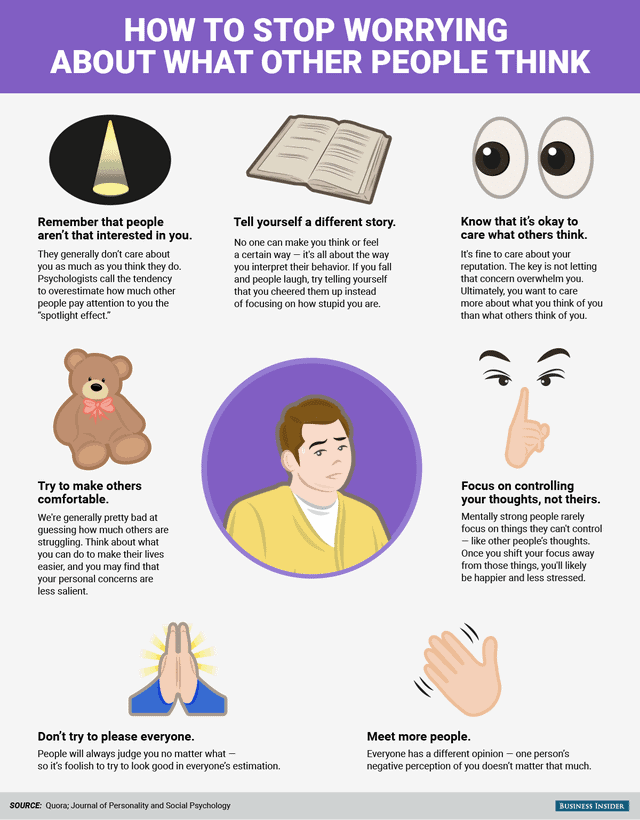
Here is a positive visual that shows you ways to stop worrying about what other people think. My favorite tactic is to “Remember that people aren’t that interested in you.” If I ever hesitate sharing something I wrote or created, I just tell myself “No one cares.” It’s so freeing! — CD
Scrivener is a specialized word processor for writing books. I’ve used to write my last three published books (non-fiction) and now I’m using it to write a novel. It’s especially useful for collecting and organizing research materials. I can add audio recordings, websites, images, and videos, making them easy to find. It also has excellent outlining and corkboarding tools. In addition to helping me write books, I use Scrivener to write long articles and reports. The Mac version is on sale for $30 (It’s usually $50). — MF
Probably the greatest invention since the Post-it Note are these 7x11 Post-it Dry Erase Sheets ($10, 3pk). They come ready to use, all you have to do is peel the liner and stick it somewhere. One sheet is small enough so that it’s not an eye-sore, and big enough so that it’s useful. I love it. — CD
On every weekly episode of the podcast Ologies, host Alie Ward interviews a researcher in an obscure field of science, that is, another “ology.” Past 200 episodes include Melittology (bees), Graphology (handwriting), Vulcanology (volcanoes), Horology (clocks), Vexillology (flags). Ward is witty, smart, playful and funny, and she asks exactly the right questions so that you too become obsessed with the same corner of the universe that you didn’t even know existed a few minutes earlier. — KK
Sinuous is a free web-based game where you control a snakey line through a shower of red dots. The goal is to avoid the red dots for as long as possible. There are also special dots that give your temporary powers if you touch them, like slowing down the red dots or creating a deflector shield. My high score is 11174. — MF
Instagram has become one kind of art museum for me. I like to get my art in diverse small doses. Among the artists I follow, I seek these accounts because they keep me surprised.
https://www.instagram.com/ifyouhigh/ — Different, odd, unexpected, weird. My favorite.
https://www.instagram.com/vikmuniz/ — Always surprising bits of beauty.
https://www.instagram.com/rawvisionmagazine/ — Select folk art from magazine.
https://www.instagram.com/geometriasagrada/ — Geometrical / mathematical art worldwide.
https://www.instagram.com/ememem.flacking/ — Creative public tile mosaics.
https://www.instagram.com/okudart/ — Colorful polygon master.
https://www.instagram.com/studioolafureliasson/ — Star artist’s tech sophisticated installations.
If you have a favorite art follow that always surprises you, let me know. — KK
Beepster is a website that lets you make synthesizer music through experimentation. It has four tracks. You can change the waveform, speed, volume, pitch, and scale by clicking buttons. It’s configured in such a way that anything you do produces a pleasant tune. — MF
I try to veer away from using filters on photos, but there are times when the scene I am seeing is so much more vibrant than what comes out in a picture. I tried out the “TikTok” iPhone photo hack, which is a specific formula for making a photo taken in natural light look like it was taken during the “golden hour,” and I love the effect. Here is a before and after picture of my dog Pablo wading through water. The exact formula is: Exposure and brilliance to 100. Highlights to -32. Shadows to -26. Lower the contrast to -30. Brightness to -15. Black point to 10. Saturation to 10. Vibrance to 8. Warmth to 10. Push the tint up to 29. Up the sharpness to 14. Definition feature to 23. Finally, slide the exposure back down to 0. — CD
I beta-tested one of Clearer Thinking’s mini-programs to help identify my greatest sources of pleasure, which is important to know, because “positive emotions are one of the pillars of well-being. By identifying your Sources of Pleasure, you can pursue them on those times you are feeling a bit low, our use them as a reward for engaging in other activities you do not feel like doing.” My sources of pleasure were mostly sensorial and not surprising to discover: animals, nature, humor. But what was surprising was the genius advice that could apply to everyone: “Coupling” to come up with ways to incorporate pleasure into your daily life. “Couple boring activities, like vacuuming your home, with something you really like to do such as listening to your favorite podcast or singing out loud.” I do love listening to standup comedy while stuck in traffic, I had never thought of listening to it while I cleaned the house. — CD
Charles Platt is a science fiction writer who was also a staff writer for Wired magazine. He is not well known, and does not have an extravagant life story, but for some reason I could not put down his multi-volume self-published autobiography which is subtitled: “How I Failed at Almost Everything.” I found his nearly day-by-day memoirs of his struggles to be a writer and zine publisher to be page-turning exciting because he had just enough success so that his inevitable personal failures would make a rollicking roller coaster ride, like a good sitcom. How will Charles screw up next? Despite the stack of unread bestsellers on my table, I’ve read Vol1, Vol 2, and Vol 3 of his An Accidental Life, and look forward to the soon to be published Vol 4 and 5. — KK
I often come across text on my computer that I can’t copy, such as error messages, screenshots, PDFs, or Kindle Cloud reader pages. I bought a $4 optical character recognition utility called TextSniper that lets me grab uncopyable text that’s on my display and save it as plain text to the clipboard. (It also reads QR and barcodes!) I quickly have become dependent on it. (It’s Mac-only.) — MF
I avoid sugar if I can help it, but I like to bake cookies and make ice cream. I’ve been using a product from Lakanto that contains erythritol and monk fruit extract. Monk fruit is a fruit indigenous to China (where it’s known as luo han guo) and is similar in appearance to an apple. It’s been used in traditional Chinese medicine for centuries, but it’s only recently become popular in the U.S. as a sweetener. Erythritol is a sugar alcohol that’s been used in Japan for decades as a sweetener. Unlike other sugar alcohols, it doesn’t cause stomach upset and it doesn’t affect blood sugar. Lakanto looks just like white sugar and can be used 1:1 in place of sugar in recipes. Unlike other non-sugar sweeteners like stevia, there’s no bitter aftertaste. — MF